An adjustable loop suture button is a fixation component designed for use in ligament reconstruction procedures where loop length and graft positioning need to be managed during fixation. The product information supplied by Well Trust presents an adjustable loop design together with a suture button and high-strength traction wires. The illustrated application is femoral fixation of the anterior cruciate ligament (ACL) and posterior cruciate ligament (PCL).
For surgeons, distributors and medical procurement teams, the main points to review include the loop adjustment method, the relationship between the loop and the graft, the button structure, the suture material, available loop specifications and compatibility with the intended surgical technique. Final product selection and use should always follow the manufacturer’s current instructions for use and the requirements of the healthcare facility.
An adjustable loop suture button combines a fixation button with a loop whose length can be managed during the fixation process. Compared with a fixed loop configuration, an adjustable loop provides a different way to handle loop length when positioning a graft through a bone tunnel. This design may be considered when the surgical technique requires controlled loop adjustment during fixation.
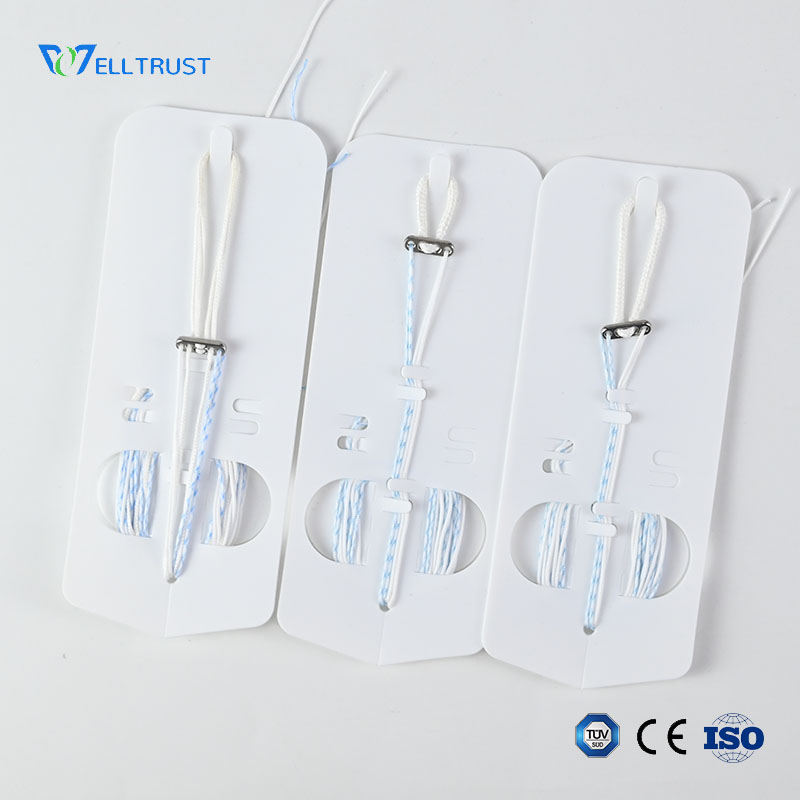
The supplied product image shows the adjustable loop, traction suture and a graft protection device. The graft protection structure is presented as a way to help reduce the possibility of the wire loop cutting into the graft during tightening. This is a product design description rather than a clinical outcome claim; the actual performance depends on the complete device system, surgical technique, tissue condition and other clinical factors.
The primary feature of this suture button is its adjustable loop. During the fixation process, the user can manage the loop according to the planned graft position and bone tunnel conditions. The adjustment method, allowable range and procedural sequence should be confirmed in the product instructions before clinical use.
The product information shows a specific graft protection device positioned around the loop area. Its stated design purpose is to help avoid the wire loop cutting into the graft during tightening. Users should assess this feature together with the suture configuration, button position and fixation technique rather than evaluating it as an isolated component.
The illustrated adjustable loop configuration includes a No. 5 high-strength traction suture. The traction suture is used as part of the handling and fixation system shown in the product material. The exact material, tensile data, sterilization status and product testing information should be obtained from the manufacturer’s technical documentation.
The supplied product material presents both adjustable loop and fixed loop suture button configurations. The fixed loop version is shown with a continuous braided or wrapped UHMWPE wire loop. The image also lists loop specifications from 15 mm to 60 mm for different bone tunnel conditions. Two No. 5 high-strength traction wires and flip loop wires are shown as pre-set components to support handling during the procedure.
| Item | Adjustable Loop | Fixed Loop |
|---|---|---|
| Loop configuration | Loop length can be managed during fixation | Pre-set loop configuration |
| Product component | Suture button with adjustable loop and graft protection structure | Suture button with continuous braided or wrapped loop |
| Displayed application | Femoral fixation in ACL and PCL reconstruction | Femoral fixation in ACL and PCL reconstruction |
| Displayed loop information | Adjustment feature shown; exact range requires confirmation | 15–60 mm loop specifications shown |
| Traction components | No. 5 high-strength traction suture shown | Two No. 5 traction wires and flip loop wires shown |
The product image identifies femoral fixation of the anterior and posterior cruciate ligaments as the application range. In this context, the suture button and loop system are selected as part of a complete reconstruction technique. The required loop configuration may depend on the bone tunnel, graft dimensions, fixation method and surgeon’s established procedure.
Because the supplied images do not provide a complete surgical protocol, they should be used for product identification and preliminary selection only. Healthcare professionals should review the current instructions for use, product size information and compatibility requirements before ordering or using the device.
The main design feature is the ability to manage loop length during the fixation process. This can help the user handle graft positioning according to the selected surgical technique and product instructions. It should not be treated as a guarantee of a specific clinical result.
An adjustable loop allows the loop length to be managed during fixation, while a fixed loop has a predetermined loop configuration. The appropriate option depends on the fixation technique, bone tunnel requirements and the manufacturer’s instructions.
The product image describes the fixed loop as a continuous braided or wrapped UHMWPE wire loop. The exact material specification and performance data should be confirmed in the current technical documentation.
The supplied image lists 15–60 mm loop specifications for the fixed loop configuration. The correct size should be selected according to the surgical plan and confirmed before ordering.
The supplied product information shows application for femoral fixation of the anterior and posterior cruciate ligaments. Specific indications, surgical steps and device compatibility should be confirmed through the manufacturer’s current product documentation.
The adjustable loop suture button is the main focus of this product range, offering a loop configuration that can be managed during the fixation process. The product information also presents a graft protection structure and a No. 5 high-strength traction suture. Alongside the adjustable loop, the range includes a fixed loop configuration with 15–60 mm loop specifications and pre-set traction components. For ACL and PCL reconstruction applications, medical professionals and purchasing teams should confirm the loop type, specifications, compatibility and current instructions for use before selecting a product.


